Modern civilization often assumes it stands at the peak of human knowledge. Advanced technology, global communication, and scientific research have transformed the world at an unprecedented pace. Yet, as researchers continue to study the ancient past, an uncomfortable truth emerges: many early civilizations possessed knowledge that modern science is still struggling to fully explain.
These societies worked without electricity, advanced machinery, or digital tools, yet they achieved results that challenge our understanding of technological progress. Their discoveries raise an important question — were ancient people more knowledgeable than we assume, or are we underestimating the complexity of early human intelligence?
Astronomical Precision Without Modern Instruments
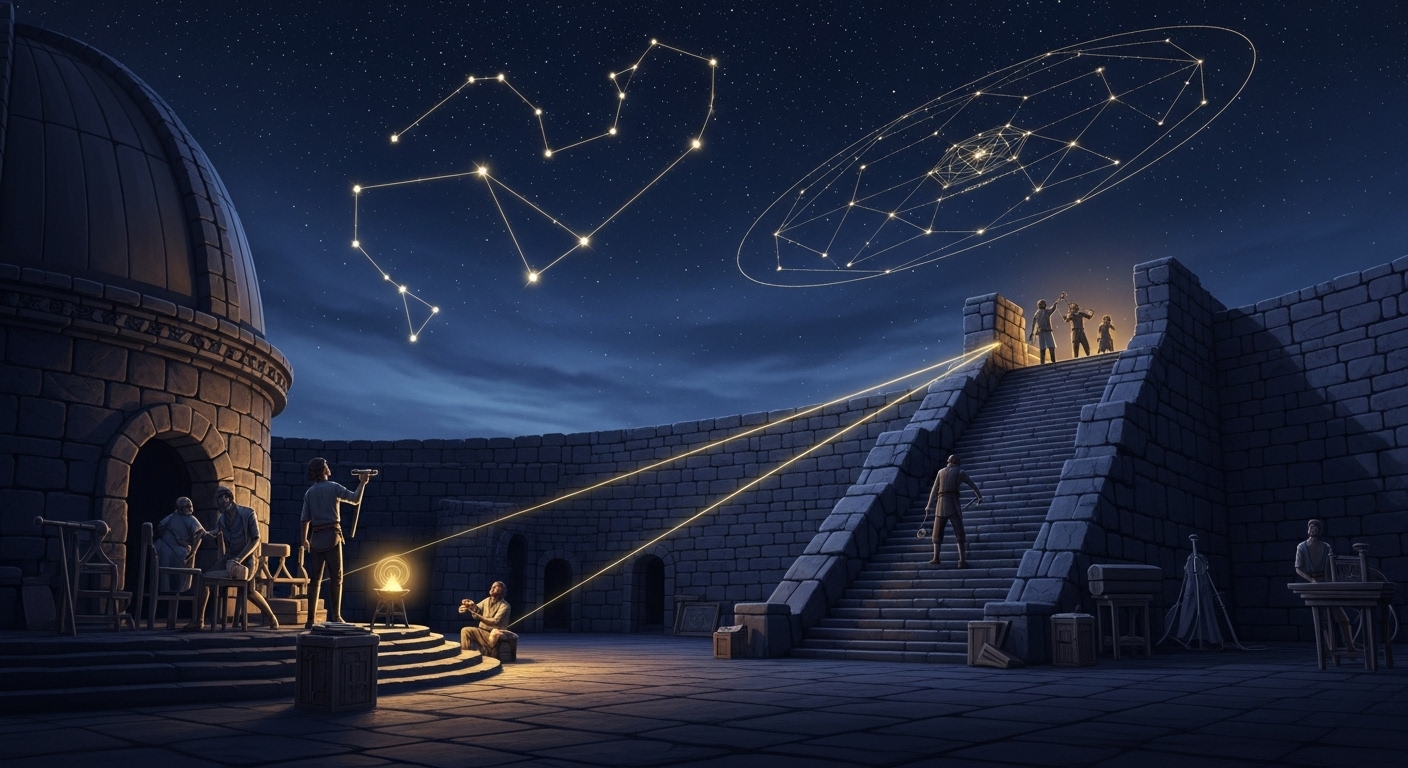
One of the most striking examples of ancient knowledge lies in astronomy. Long before telescopes and computers, ancient civilizations tracked celestial movements with remarkable accuracy.
Stone structures, temples, and monuments around the world were aligned with solstices, equinoxes, and planetary cycles. These alignments were not accidental. They required long-term observation, precise calculations, and an advanced understanding of the sky.
Some ancient calendars measured solar years with a margin of error so small that it rivals modern systems. These calculations were essential for agriculture, navigation, and religious life — yet they were achieved using only the naked eye and simple tools.
Modern scientists still debate how these observations were maintained consistently across generations without written mathematical formulas or standardized instruments.
Engineering Feats That Defy Simple Explanation
Ancient engineering continues to puzzle experts. Massive stone blocks were transported across long distances and assembled with extraordinary precision. In many cases, the stones fit together so tightly that even modern tools struggle to replicate the joints.
These structures were built without cranes, steel, or powered machinery. Some stones weigh tens or even hundreds of tons, yet they were lifted, positioned, and aligned with incredible accuracy.
Modern engineering explains how such feats might be possible in theory, but practical demonstrations often fall short. The absence of definitive evidence for the tools and methods used leaves important questions unanswered.
Mathematical Understanding Before Formal Mathematics
Mathematics did not begin with textbooks or modern notation. Ancient societies used mathematical principles long before formal systems were documented.
Geometric ratios, symmetrical design, and proportional planning appear consistently in ancient architecture. City layouts, temples, and monuments reflect a deep understanding of balance and measurement.
Some structures encode mathematical constants in their dimensions — not as coincidence, but as intentional design. Whether these constants were understood symbolically, practically, or philosophically remains a subject of debate.
What is clear is that ancient builders applied mathematical knowledge effectively, even without standardized symbols or equations.
Medical Knowledge Beyond Its Time
Ancient medicine was more sophisticated than often assumed. Archaeological evidence shows that early doctors performed surgeries, treated fractures, and practiced forms of anesthesia.
Skulls with clean surgical openings indicate controlled procedures rather than accidental trauma. Some ancient texts describe herbal remedies whose chemical properties are only now being validated by modern science.
While ancient medicine lacked the technology of modern healthcare, it often emphasized holistic understanding of the human body — including diet, environment, and mental health — principles that modern medicine is increasingly rediscovering.
Materials Science Without Industrial Technology
Ancient civilizations developed materials that remain difficult to reproduce today. Some ancient concretes have survived thousands of years while modern versions degrade within decades.
Metallurgical techniques allowed early societies to create durable alloys and corrosion-resistant metals without modern furnaces or chemical analysis. In some cases, the exact formulas used were lost over time.
Modern researchers continue to study these materials, not just for historical curiosity, but to improve contemporary construction and sustainability.
Knowledge Preserved Without Modern Records
One of the most puzzling aspects of ancient knowledge is how it was preserved. Many civilizations relied on oral tradition, symbolic art, and architectural design rather than written documentation.
This knowledge was embedded in rituals, myths, and cultural practices. When these systems collapsed, much of the information vanished with them.
Modern science depends on written data and digital storage. Ancient societies depended on memory, observation, and repetition — methods that proved effective for centuries but fragile in the face of disruption.
Why Modern Science Still Seeks Answers
The challenge for modern science is not accepting that ancient people were intelligent — it is understanding how they organized, transmitted, and applied knowledge so effectively with limited tools.
Many ancient achievements do not fit neatly into linear models of progress. Instead, they suggest cycles of discovery, loss, and rediscovery.
This does not diminish modern science. Rather, it expands its perspective. By studying ancient knowledge seriously, researchers gain insights into human adaptability, creativity, and problem-solving across time.
What Ancient Knowledge Teaches Us Today
Ancient civilizations remind us that intelligence is not defined by technology alone. Innovation arises from observation, necessity, and collaboration.
Modern society may possess advanced tools, but ancient people mastered their environment with efficiency and long-term thinking. Their achievements encourage humility — and curiosity.
As science continues to explore the past, one truth becomes clear: the story of human knowledge is far from complete. The ancient world still holds lessons waiting to be understood.