The Great Endurance: Finding Meaning in the Age Before Medicine
Explore the raw reality of the pre-medical era. Discover how our ancestors used ancient secrets, herbalism, and sheer grit to survive a world without doctors.
1. The Raw Dialogue with Nature
Before the first sterile scalpel touched skin or the first vaccine was synthesized in a vial, humanity existed in a state of raw, unmediated biological reality. For the vast majority of our history, "medicine" was not a science governed by peer-reviewed journals, but a desperate, poetic dialogue with the natural world. Survival wasn’t a guarantee provided by a healthcare system; it was a daily negotiation with a landscape that was as lethal as it was life-giving. In this era, the human body wasn't seen as a machine with replaceable parts, but as a vessel influenced by the heavy pull of the moon, the whims of the gods, and the unseen spirits of the forest.
2. An Intimacy with the Unbearable
To live in the pre-medical world was to maintain a profound, almost casual intimacy with pain. Without the luxury of anesthesia or modern analgesics, physical suffering was an expected companion of the human condition rather than an anomaly to be eradicated. A simple abscessed tooth could become a weeks-long ordeal of agony; a minor scrape from a rusted tool was a high-stakes gamble with the specter of sepsis. Yet, this constant proximity to mortality fostered a psychological grit that we’ve largely traded for modern comfort. People didn’t look for a "cure" in the way we do now; they looked for the spiritual fortitude to endure, finding solace in communal rituals and the shared weight of being alive.
3. Keepers of the Hearth and Root
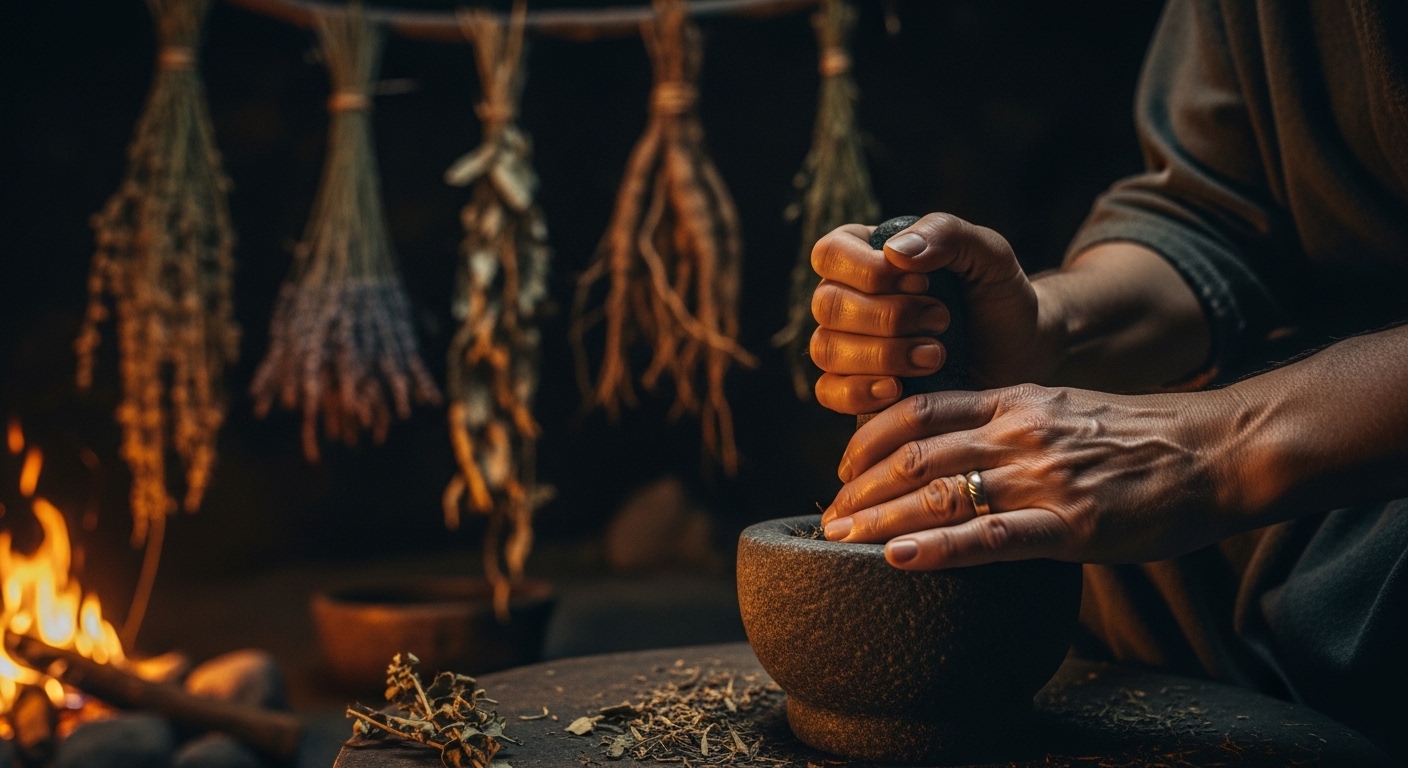
The healers of this era, the shamans, the midwives, and the village elders, were the original keepers of the world's secrets. Their knowledge wasn't stored in digital databases but was etched into memory and passed down through oral traditions whispered by the hearth. Every meadow was a pharmacy, and every root held a hidden power. We see the sophistication of this "primitive" knowledge in the remains of the "Iceman" Ötzi, who carried specific medicinal fungi to treat parasites over 5,000 years ago. These early practitioners understood a truth we are only now rediscovering: that the mind and body are an inseparable loop. They treated the spirit with song and ceremony while applying poultices of willow bark, the ancient, bitter ancestor of our modern aspirin, to the fevered brow.
4. The Instinct of the First Responder
Life was dictated by the harsh, honest rhythms of the seasons. Because there were no refrigerated antibiotics or emergency rooms, human populations were kept in a fragile balance with their environment. This forced a level of ecological intelligence that has largely vanished. An ancient hunter or gatherer knew the properties of every plant in a ten-mile radius because their life depended on it. There was no "expert" to call; you were your own first responder, your own pharmacist, and your own priest. This self-reliance created a version of humanity that was deeply attuned to the nuances of the body’s internal signals, signals we often drown out today with a pill.
5. A Sanctuary in the Collective
Socially, the absence of medicine created a culture that valued the collective over the individual. Death was frequent, often sudden, and entirely public. This transparency ensured that every member of the tribe, from the youngest child to the eldest, understood the staggering fragility of life. Longevity was a rare and sacred gift, and those who managed to reach old age were revered as living libraries of survival. The milestones of existence, birth and death, happened in the center of the home, witnessed by all. This didn't make life cheaper; it made every sunrise feel like a hard-won victory for the entire community.
6. The Quiet Irony of Progress
There is a certain irony in our modern perspective; we look back at our ancestors with a mixture of pity and horror at their "primitive" ways. Yet, in their world, the water was untainted, the air was silent of industrial roar, and the food was gathered from the earth, not a factory. While they lacked the technology to extend life, they often possessed a deeper quality of presence. They lived in the "now" because the "tomorrow" was never promised. Their struggle wasn't against a bureaucratic system, but against the raw elements of the earth, a struggle that shaped our DNA and defined our species' resilience for hundreds of thousands of years.
7. Descendants of the Impossible
As we move further into the age of bio-hacking and synthetic longevity, it is worth pausing to remember the era of the Great Endurance. We are the descendants of those who survived the impossible, those who birthed children in the dirt, who set broken bones with sticks and mud, and who faced the darkness without a flashlight. Their history is not just a tale of suffering; it is a testament to the sheer, unyielding will of the human spirit to persist against the odds. Life before medicine was undoubtedly shorter and more perilous, but it was a life lived in a fierce, vivid harmony with the ancient secrets of the natural world.