Londinium: The Roman Secrets of Ancient London
Discover the hidden history of Londinium. From Boudica’s fire to the secret Mithraic cults, explore the 8 deepest Roman secrets buried beneath the streets of modern London.
1. The Synthetic City: Birth on the Thames
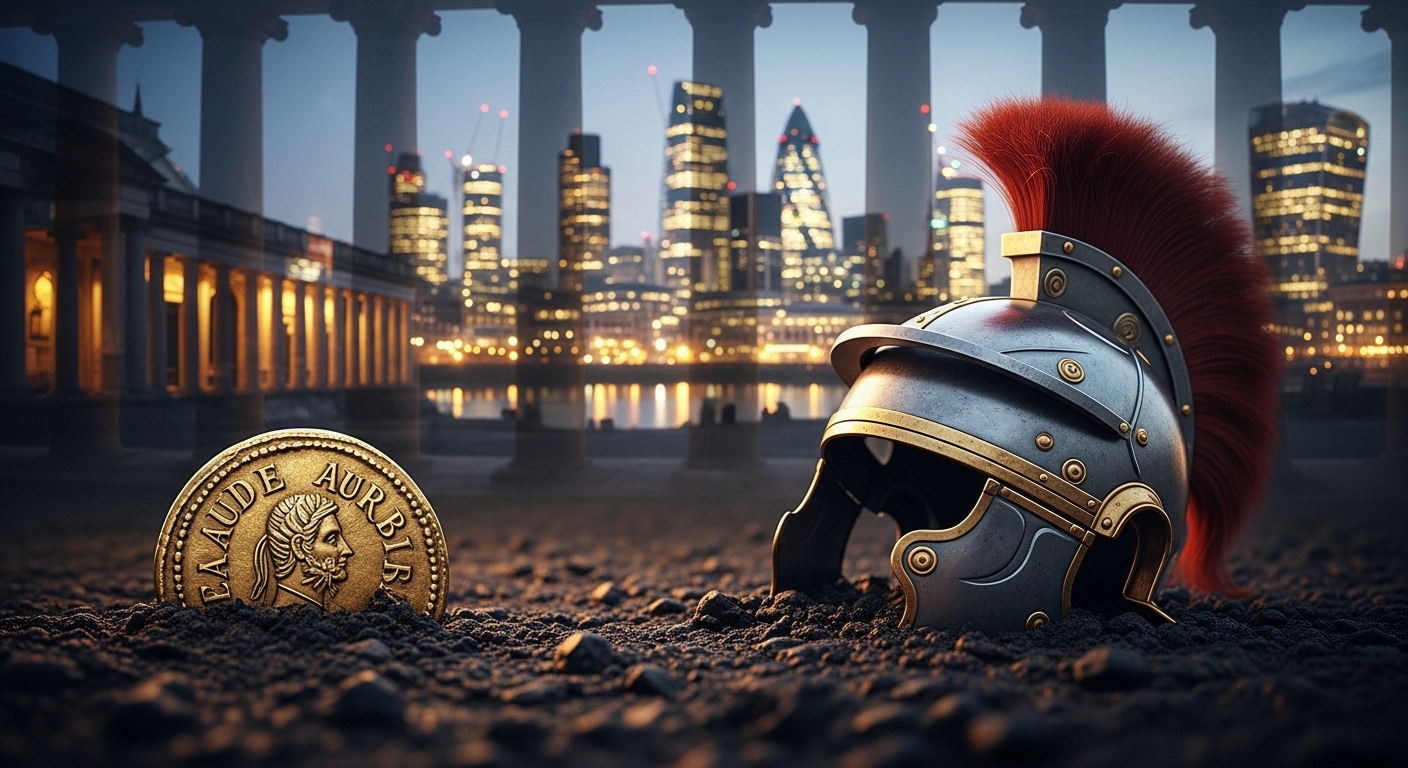
Beneath the glass-and-steel arteries of modern London lies the ghost of a frontier powerhouse: **Londinium**. Founded by the Romans around 47 CE, this was not a city born of ancient tribal roots, but a deliberate, synthetic creation of an empire. It was a speculative venture of timber and clay, positioned at the lowest crossing point of the River Thames to facilitate deep-sea trade and rapid troop movement. While today’s commuters rush through the City, they walk mere feet above a buried world where Latin was the tongue of trade, and the Roman eagle cast a long administrative shadow over the muddy, tidal banks of the North.
2. The Red Layer: A Baptism of Fire
The city’s early years were defined by a brutal baptism of fire that nearly erased it from the map. In 60 CE, the Iceni queen **Boudica** led a scorched-earth rebellion that leveled the nascent settlement, leaving a distinct "red layer" of oxidized debris and burnt daub that archaeologists still find in the soil today. This layer of ash serves as a silent, grim horizon line in London’s stratigraphy, marking the moment the Roman dream almost flickered out in a haze of smoke and slaughter. Yet, with the cold pragmatism characteristic of the Empire, the Romans did not retreat; they rebuilt with a ferocious sense of permanence, transforming a scarred outpost into the glittering provincial capital of Britannia.
3. The Forum: A Mediterranean Heart in a Northern Land
The architectural ambition of the rebuilt Londinium was nothing short of a Mediterranean fever dream imported to the damp British climate. By the 2nd century, the city boasted the largest **forum** north of the Alps, a massive civic complex covering nearly eight acres of prime land. This was the beating heart of Roman secret-keeping and law-making, a sprawling courtyard surrounded by administrative offices where merchants from as far as North Africa bartered for grain and wool. To walk its porticos was to witness the sheer audacity of Rome: a sprawling, paved marble lungs breathing life into a land that, only decades prior, had been a patchwork of iron-age forests and tribal marshes.
4. The Mithraeum: Secrets of the Subterranean Cult
Deep within the shadows of the city’s foundations lies one of its most enigmatic secrets: the **Mithraeum**. Discovered in 1954 during post-war reconstruction, this subterranean temple was dedicated to the mystery cult of Mithras, a god favored by soldiers and high-ranking officials. The temple was designed to mimic a cave, a place of ritualistic silence and flickering torchlight where members underwent esoteric initiations far from the prying eyes of the public. This hidden sanctuary reminds us that Londinium was not just a hub of commerce, but a cauldron of spiritual diversity, housing gods that had traveled thousands of miles across the Silk Road to find a home in the London mud.
5. The Thames Archive: Relics of the Deep
The Thames itself remains the city’s greatest repository of lost history, acting as a watery vault for two millennia. For centuries, the river functioned as a ritualistic dumping ground for offerings, weaponry, and everyday refuse, preserving organic materials in its anaerobic silt. From the mud, archaeologists have pulled leather sandals that look as though they were kicked off yesterday and wax writing tablets that preserve the earliest handwritten documents in Britain. One such tablet, dated to **January 8, 57 CE**, is a mundane financial record, yet it represents the precise moment London entered the written historical record, a secret ledger of a city finally finding its voice.
6. The Great Wall: Defining the Urban Boundary
Security in Londinium was an obsession, evidenced by the gargantuan **London Wall** constructed at the turn of the 3rd century. This three-mile defensive perimeter, built from Kentish ragstone and ironstone, defined the city’s shape and psychological boundaries for the next 1,600 years. Even today, the jagged remains of the wall near Tower Hill or the Barbican serve as a skeletal reminder of a city that was constantly looking over its shoulder toward the restless interior of the province. It was a fortress of civilization, a stone boundary between the Roman "ordered" world and the "barbarian" wilds that sat just beyond the city gates.
7. The Amphitheatre: Blood and Spectacle Beneath the Guildhall
One of the most startling discoveries of recent decades is the **London Amphitheatre**, which remained hidden beneath the Guildhall Yard for over a thousand years. For centuries, its exact location was a total mystery until its curved stone walls were unearthed in 1988, revealing a venue capable of holding 6,000 spectators. Here, the "secrets" of Roman entertainment were laid bare: a venue for gladiatorial combat, public executions, and wild animal hunts. The juxtaposition of the refined Roman legal system in the forum and the visceral, bloody spectacles in the amphitheater reveals the dual nature of Londinium, a city of high intellect and terrifying, state-sanctioned violence.
8. The Long Fading: An Echo in the Stone
As the Roman Empire began to contract in the 5th century, the lights of Londinium did not go out all at once; they faded into a "dark earth" period of slow abandonment. The grand villas were left to crumble, the heating systems failed, and the once-bustling quays fell silent as the city's inhabitants drifted away to the safety of the countryside. Yet, the Roman blueprint was too powerful to be completely erased by time or neglect. The streets we walk today, the location of our bridges, and the very soul of the "Square Mile" are the echoes of that ancient Roman secret. Londinium never truly died; it simply waited beneath the pavement to be rediscovered by the modern world.