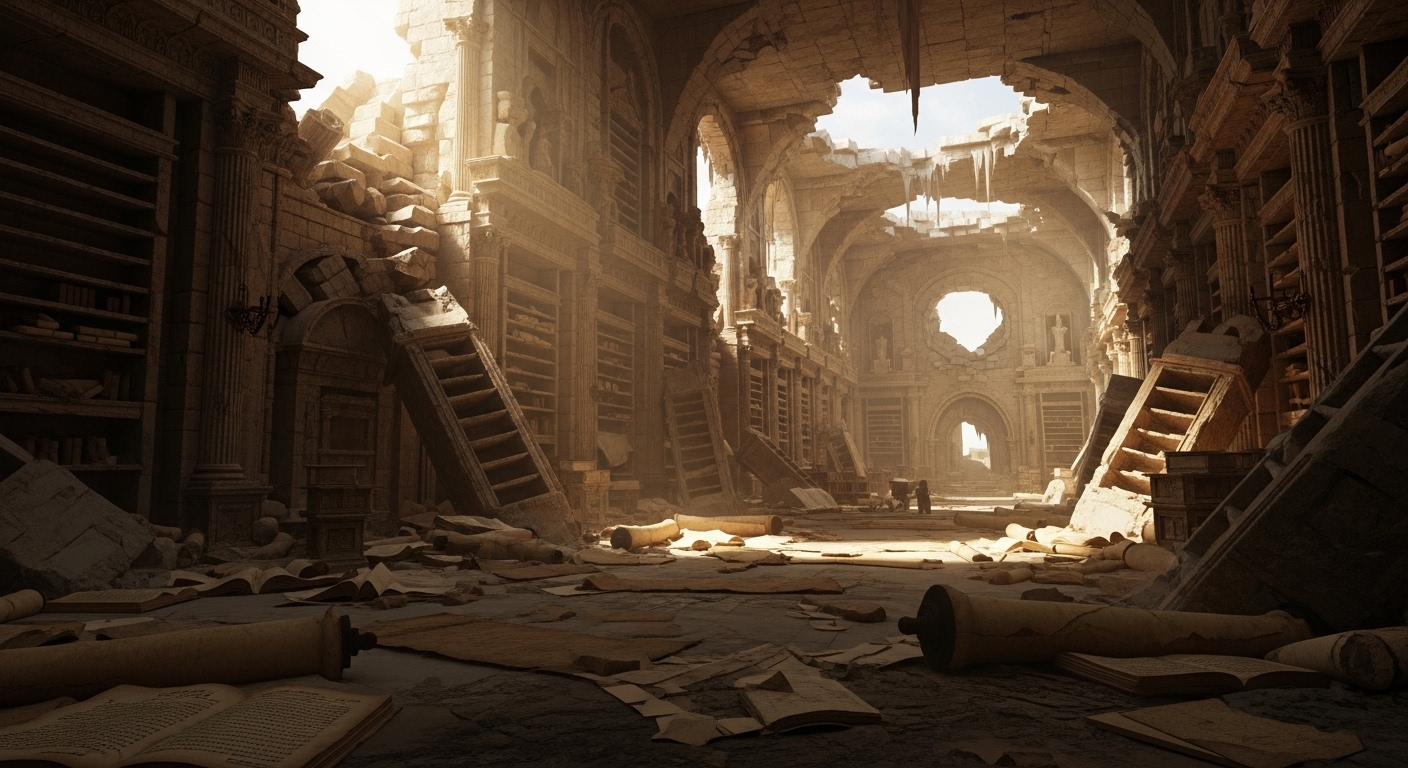
History is often presented as a clean, linear story: primitive societies slowly evolved into advanced civilizations, eventually leading to the modern world we know today. But this version of history is incomplete. Beneath the surface lies a far more complex reality — one shaped by civilizations that rose, flourished, and vanished long before modern nations existed.
Many of these societies were not primitive at all. They possessed sophisticated knowledge of astronomy, engineering, agriculture, and social organization. Their ideas, innovations, and structures quietly influenced later cultures, even though their names were erased from textbooks. This is the hidden history of forgotten civilizations — and their impact is far greater than most people realize.
Why Civilizations Disappear From History
Civilizations do not vanish overnight, but history often forgets them just as quickly. There are several reasons why entire cultures disappear from the historical record.
Natural disasters such as earthquakes, floods, droughts, and volcanic eruptions have destroyed cities and displaced populations. Climate change has repeatedly altered landscapes, turning fertile regions into deserts and forcing civilizations to abandon their homes.
Human actions have been equally destructive. Wars, invasions, and conquests frequently resulted in the burning of cities, the destruction of records, and the deliberate erasure of cultural identity. When conquerors rewrite history, they often replace local knowledge with their own narratives.
Another major factor is the loss of written records. Many ancient societies relied on oral traditions rather than written language. When those traditions were interrupted — by disease, migration, or violence — their history vanished with them.
Advanced Knowledge Long Before the Modern Age
One of the most surprising discoveries of modern archaeology is how advanced many ancient civilizations truly were.
Long before modern science, ancient societies tracked the movement of the sun, moon, and stars with remarkable accuracy. They built calendars aligned with astronomical cycles, predicted seasonal changes, and organized agriculture around celestial events.
Engineering achievements from the ancient world still puzzle experts today. Massive stone structures were built with precision that rivals modern construction, often without metal tools, wheels, or written blueprints. These structures were designed to endure for thousands of years — and many still stand.
Mathematical concepts also emerged far earlier than once believed. Ancient cultures understood geometry, ratios, and measurements that allowed them to design cities, irrigation systems, and monuments with astonishing precision.
Forgotten Innovators of Urban Planning
Modern cities did not invent urban planning. Long before skyscrapers and highways, ancient civilizations designed complex urban environments.
Archaeological evidence shows that some forgotten societies built cities with grid layouts, drainage systems, and designated zones for living, commerce, and ceremony. Roads were engineered to manage foot traffic efficiently, and water systems delivered clean water while removing waste.
These early cities prioritized sustainability. Buildings were constructed using local materials suited to the climate, reducing environmental strain. Green spaces and agricultural zones were often integrated directly into urban life, creating a balance between nature and civilization that modern cities still struggle to achieve.
Agriculture That Fed Entire Populations
The survival of any civilization depends on food, and ancient societies mastered agriculture in ways that remain impressive today.
Terraced farming allowed crops to grow on steep terrain while preventing soil erosion. Irrigation canals carried water across vast distances, transforming dry land into fertile fields. Crop rotation and soil management techniques ensured long-term productivity.
Some forgotten civilizations cultivated plants that are still staples of the modern diet. Their agricultural knowledge laid the foundation for food systems that continue to sustain billions of people worldwide.
How Forgotten Civilizations Shaped Later Cultures
Even when civilizations disappear, their influence rarely does. Knowledge spreads through migration, trade, and cultural exchange.
Later societies often built upon the foundations left behind by earlier ones. Architectural styles, religious symbols, and social structures were adapted and transformed over generations. In many cases, later civilizations received credit for ideas they inherited rather than invented.
Languages absorbed words, concepts, and symbols from older cultures. Religious traditions preserved fragments of ancient beliefs, encoded as myths and rituals. What appears new is often ancient knowledge wearing a different name.
Why These Civilizations Were Ignored for So Long
For centuries, historians focused primarily on civilizations that left extensive written records or aligned with dominant cultural narratives. Societies without monumental texts or political continuity were dismissed as insignificant or primitive.
Colonial perspectives also played a role. European scholars often undervalued non-European civilizations, interpreting their achievements through biased frameworks. This led to the systematic underrepresentation of entire cultures in mainstream history.
Only in recent decades has archaeology begun to correct these assumptions. New technologies such as satellite imaging, ground-penetrating radar, and advanced dating methods have revealed lost cities and rewritten historical timelines.
What Modern Society Still Learns From the Past
Forgotten civilizations challenge the idea that progress moves in a straight line. They remind us that knowledge can be gained, lost, and rediscovered.
Modern engineers study ancient construction techniques to understand durability and sustainability. Environmental scientists examine historical climate adaptation strategies. Social researchers explore how ancient societies organized themselves without modern technology.
The past is not irrelevant — it is a repository of solutions developed under conditions far more limited than our own.
Why Hidden History Matters Today
Understanding forgotten civilizations is not just an academic exercise. It changes how we view human potential.
When we recognize that ancient societies achieved greatness without modern tools, we gain perspective on what is possible today. We also learn humility — realizing that modern civilization is not the first to reach advanced levels of knowledge, and may not be the last.
History is incomplete, constantly evolving as new discoveries emerge. The civilizations we have forgotten may still have lessons to teach us — if we are willing to look beyond the surface of the past.